Showing posts with label Old West. Show all posts

Sunday, September 12, 2021

Elmer McCurdy, Part Two

By Carrie Aulenbacher, WMD Managing Editor
Editor's Note: This is the conclusion of Elmer McCurdy, the escape artist, part one, published two weeks prior. To read part one, click here. --Al Colombo

I love to see the towns
 a-passin' by
And to ride these rails, 
'neath God's blue sky

Let me travel this land 
from the mountains to the sea
'Cause that's the life I believe, 
He meant for me

                                                                   --Hank Williams Sr, Ramblin' Man


Los Angeles County Coroner’s Office, 1976

"He what?"  An assistant to the coroner did a double take, trying to comprehend the discovery even as he held the container with the recovered bullet.

"This John Doe was murdered."  The assistant closed his eyes and pinched the bridge of his nose.

"Well, a place like Laff in the Dark is a great place to hide a body if you want to get away with murder."  He sighed as he heard himself say such a strange sentence.

"A murder from at least 50 some odd years ago?"  The coroner said.  The assistant lifted his head in amazement.

"The body has high amounts of arsenic.  They haven't embalmed bodies with that since the twenties and this is looking to be more than 40 years post mortem."

The thought hung unspoken in the air between them: "Who IS this guy?"


Elmer McCurdy
The 1,700+ mile journey Elmer McCurdy took in 31 years of life could have never compared to the thousands of miles he would accumulate in the next 66 years. 

As the sheriff's posse cleaned up the scene, McCurdy's body was taken to the undertaker in Pawhuska, Oklahoma.  The Johnson Funeral Home agreed to prepare McCurdy's body but the search was on to find kin to not only claim the body but to pay for services. In order to make sure the body lasted until family members showed up, the mortuary used an arsenic-based preservative to preserve Elmer. This was common practice before the deadly effects of exposure to arsenic were fully understood.

So McCurdy was shaved, dressed and embalmed. But no family showed up. The undertaker, Joseph L. Johnson, was out the money he invested in preparing the body so he decided to earn a bit back. His idea was to prop Elmer's body up in the back of his shop and charge folks a nickel to take a look at him. With a rifle for a prop, Elmer was posed and advertised as "The Bandit Who Wouldn't Give Up".

Exhibiting McCurdy earned him money and attention. Word began to spread about "The Embalmed Bandit", "The Oklahoma Outlaw" - Elmer began to be "The Mystery Man of Many Aliases" in this second incarnation. Carnival owners started popping up offering Mr. Johnson a fee to buy Elmer off of him. But being a man of principle, he refused in the hopes that rightful family would come eventually.

Almost five years later to the day Elmer McCurdy was killed, in October of 1916, Johnson thought his wish had finally transpired. Aver McCurdy showed up at the funeral home, explaining that he was Elmer's brother and had been in contact with the sheriff and a local attorney about gaining possession of his brother's remains to have him properly taken home and buried.

Agreeing to the brother, Johnson prepared things and the following day, Aver's brother, Wayne McCurdy, showed up and they both gladly loaded up Elmer for the trek home to his eternal rest.  Johnson's fees were paid, everything was set right and everyone breathed a sigh of relief that things were finally over for the unlucky train robber.

And those who breathed the biggest sigh of relief were Aver and Wayne McCurdy - better known as the brothers Patterson.  James and Charles Patterson were owners of The Great Patterson Carnival Shows, a circus and sideshow act that had heard of the embalmed bandit. Knowing it would make for a great curiosity, their scheme worked. They had the body. Now to make real money.

For the next few years, the Pattersons traveled with Elmer McCurdy in their circus. Some sources say that Patterson sold the circus off in 1922, some say 1925, but for all intents and purposes, it is safe to say that regardless of what exact year, the circus toured the Eastern United States in the estimate of 3,500 miles a season. A located 1924 circus schedule of the Gentry/Patterson circus, courtesy of the Pfening collection shows a route between Kansas and Connecticut between April and October.

Little did McCurdy's family know that, for several years, he came within less than 200 miles of finally being home. Elmer could have never imagined that the 1,700 miles between Maine and Oklahoma he journeyed in life would pale in comparison to his travels in the afterlife. Estimating the circuit from the 1924 schedule, it is easily possible that Elmer traveled ten times further dead than he ever did alive - covering over 15,000 miles in the circus!

As the years passed, the Pattersons sold the circus to Louis Sonney, who used the body in his 'Traveling Museum of Crime' and changed his history to that of a crazed drug user who took his own life when surrounded by police. The embalming and years of touring in less than ideal conditions had worn at the body and lent to the fantastic story dreamed up by Sonney. There Elmer remained amid wax figures of Bill Doolin and Jesse James for the next decade.

In the mid 1930's, Elmer briefly took a break from the sideshow life to help film director Dwayne Esper advertise his new movie Narcotic! in theaters. He haunted the movie theaters as a dead dope fiend in the hopes of deterring the public of experimenting with drugs. Afterwards, he was returned to Sonney.

When Sonney stopped touring, everything went into storage, including Elmer McCurdy. With Sonney's death in 1949, everything was forgotten for a time. When filming began in the mid 1960's for the horror film, She Freak, McCurdy's body came out of storage with permission of Sonney's son, Dan, and was lent to be featured as a prop in the film. After the film was released, the family sold the body along with other wax mannequins from storage to Spoony Singh, owner of The Hollywood Wax Museum.

Now thought to be a wax mannequin, Singh lent Elmer and some other mannequins to two Canadian men who were hosting a feature at Mount Rushmore. Now over five decades since being embalmed, McCurdy's body was showing signs of wear and the harsh elements of the South Dakota landscape did no favors. Elmer endured a windstorm during his showcase there and lost the tips of his ears and some fingers and toes.

Once returned to Singh, he saw the damage and decided that the figure was too gruesome to be displayed any further and sold it to a Long Beach California amusement park company called The Pike. Mostly known for its boardwalk attractions, The Pike had a ride called 'Laff In The Dark' where Elmer was set up as a spooky character to scare riders. Now painted fluorescent red, he was a grotesques ghoul in a funhouse on the other side of the country from where he started. Hanging from a rope, he startled and repulsed, all the while his real truth remaining a mystery.

Almost five years later, now the mid 1970's, a crew came in to use The Pike, and specifically the Laff In The Dark area for filming of an episode of 'The Six Million Dollar Man'. As a prop man was setting up a shot, he unfortunately tried to move McCurdy's body as it hung from the gallows in the funhouse ride and broke off Elmer's arm. Seeing that the mannequin had bones, authorities were immediately notified and McCurdy was taken to the Los Angeles coroner's office.

With expert help from Dr. Joseph Choi, it was determined that this had been a man in his 30's who had perished from a gunshot wound. Even with the damage from years of touring the country, he discovered the original incisions from the autopsy and embalming over sixty years ago. He tested the body and found the high levels of arsenic, the evidence of tuberculosis, the bullet jacket from the sheriff's posse and even tickets in Elmer's mouth from Sonney's traveling crime museum shows.

With the tickets placing McCurdy back in the 20's and the bullet jacket being a gas check design, which was first used in 1905, investigators began to approximate the time in which the body had lived. By contacting Sonney's son, Dan, to ask about the tickets in Elmer's mouth, Dan verified that his father had purchased the mummified body from a circus back in the day and gave the name Elmer McCurdy.

Forensic Anthropologists were called in to radiograph the skull and use a superimposition technique to try and match old photographs to the skull. The examination lined up and it was indeed the unsuccessful train robber from last century. The media got wind of the story and that December of 1976, everyone was hearing about the strange case of the funhouse mannequin who turned out to be real.

Funeral homes contacted the LA coroner's office to offer burial services free of charge. But just like Joseph Johnson from decades ago, officials held onto Elmer in the hopes that a direct descendant would come forward to claim their relative. Elmer's luck, as it was in life, was the same in death and no living family members contacted them.

As it turned out, Fred Olds, who represented the Indian Territory Posse of Oklahoma Westerns, requested to accept the body and give it a proper burial in Oklahoma. Working with the county, Olds was finally given custody.

That spring, April 22, 1977, with a proper horse drawn hearse and a plain pine coffin, Elmer McCurdy's remains were taken to Summit View Cemetery in Guthrie, Oklahoma. There, in the 'Boot Hill' section of the grounds, his body was finally interred alongside other noted Oklahoma outlaws like Bill Doolin. Over 300 people came to attend the burial and pay respects. To insure that the body would not be disturbed, two feet of concrete was poured over top the grave.

A little over one hundred miles from where he had breathed his last in 1911, Elmer McCurdy was finally at rest.


In a strange postscript to this tale:

The following summer, newsstands carried an issue of Johah Hex, a DC comic about a gunslinger having supernatural adventures. In the special series #16, an aging Hex is shot and killed, sent to a taxidermist to be preserved and then the body endures a series of adventures similar to a certain Mr. McCurdy. Although the character does not eventually get a peaceful rest as Elmer did in real life, it makes one wonder whether fans of the comic book hero realized that, in this case, fact was much stranger than fiction.

And when I'm go-one 
and at my grave you stand
Just say God called home 
your Ra-amblin' Man

-- Hank Williams Sr,  Ramblin' Man
Editor's Note: Be sure to Carrie new Facebook Page! Click Here!

About Carrie Aulenbacher

I’m a working mom who’s been at her first official job for 19 years now. I’m a mom and wife who loves spending time outside exploring our woods and enjoying all sorts of nature. Just ask my friends on Facebook and they’ll tell you that my bug pictures are getting to be an obsession with me! 

Visit Carrie's Partner Page: click here!


   Please post a comment below!   

Sunday, August 29, 2021

The 97 year journey of 31 year old bank robber, Elmer McCurdy

By Carrie Aulenbacher, WMD Managing Editor


"Some folks might say 
that I'm no good
That I wouldn't settle down
if I could

But when that open road
starts to callin' me
there's something oe'er the hill
that I gotta see."

                           --Hank Williams Sr, Ramblin' Man


Long Beach, California, 1976

"Uh, Boss?" The prop man called out.
"Thought I told you to get the shot set up-" The words stop as an arm comes into view.
"How detailed do they make these mannequins?" The tone of his voice gave pause.
"Just get it moved already!  What's wrong with-"  

The two stood there looking at the arm that used to be suspended from a fluorescent red spray-painted body in a makeshift gallows inside The Pike Amusement Zone 'Laff in the Dark' carnival area.  

"Thought they used wire, not bones..."

How does a bank robber from the 1880's go on a 66-year-long journey after being killed by a sheriffs posse? The curious tale of Elmer McCurdy is one not to be missed.


A New Year's baby is said to always have luck on his or her side.  But when Elmer McCurdy was born on January 1, 1880, luck was running short.

Elmer McCurdy (image)Born to 17-year-old Sadie McCurdy on that cold January day, Elmer's father was never known. Whether she had been with her cousin, Charles, or someone else, no father ever came forward to claim or raise Elmer. Sadie's brother, George, adopted Elmer to save her the shame of the situation.  After he passed away from tuberculosis in 1890, Sadie and her sister-in-law, Helen, moved north to Bangor.  It would be well into his childhood before events transpired so that 'Aunt Sadie' would explain to Elmer that Helen was his aunt, not his mother. Turning his world on its ear, the news sent Elmer into tumultuous teenage years of drinking and rebellion. The alcoholism would follow him his entire life.

Returning south to Washington, Maine, Elmer moved in with his grandfather and learned the trade of being a plumber. Things went smoothly for a few years until the economic downturn of 1898 when Elmer lost his job. Two years later in the hot summer of 1900, Elmer's mother suddenly died of a ruptured ulcer and his grandfather passed a short month later after suffering with Bright's disease.

Elmer took to rambling and drifting, taking jobs as a lead miner and a plumber. The alcoholism prevented these from becoming long term jobs, however, and Elmer eventually left mining and landed in Kansas. Troubles followed as he was arrested there for public intoxication, forcing him to move on to Missouri.

By 1907, he enlisted in the army and was assigned to Fort Leavenworth as a machine gun operator.  Elmer was trained to use nitroglycerin for demolition purposes. His enlisted years passed quietly and he was honorably discharged in November of 1910.  He would be dead less than one year later.

McCurdy's rambling led him back to Kansas where he met up with an Army buddy and they got arrested for possessing burglary paraphernalia. At the trial, the judge believed their story of their honest need for tools such as chisels, hacksaws, gunpowder, money sacks, etc., because of their work in inventing a foot-operated machine gun and found him not guilty. He was released in January, shortly after his 31st birthday.

Undeterred, Elmer took to the idea of using his knowledge of nitroglycerin in new robbery attempts. Two months after his release, McCurdy was in Oklahoma where he and three associates had devised a plan to rob the Iron Mountain-Missouri Pacific train.  Word in town was that one of the train cars was transporting a safe with $4,000 inside.

Although they successfully stopped the train and found said safe, the overzealous McCurdy used too much nitroglycerin to break the safe open. Not only was the safe destroyed but any paper monies inside were burnt up. All they escaped with was a melted hunk of $450 worth of silver coins.

That fall, Elmer found two new accomplices to help him rob The Citizens Bank in Chautauqua, Kansas. His bad luck fell the other way this time, however, and the initial charge of nitroglycerin was only enough to blow the bank's outer vault door. The second charge placed on the safe didn't even ignite and they had to run with only the $150 in coinage that was in a tray outside the safe.

To avoid the law, the group split up and McCurdy ended up at Charlie Revard's ranch in Oklahoma where he hid out in the hayshed for a few weeks and drank his time away. Little did his friend, Charlie, know what had gone on or what was yet to come.

Elmer McCurdy somehow found out that a $400,000 royalty payment to the Osage Nation was being transported along the Missouri-Kansas-Texas Railroad that September. The rail line had often been referred to as 'The MKT' which eventually became shortened to 'The K-T'.  Soon, everyone colloquially referred to trains along this line as 'Katy Trains'.

This Katy Train caught Elmer's eye and soon, he had two more hands to help set up his new robbery plans. Unfortunately, with the frequency of 'Katy Trains' along the MKT line in those days, McCurdy's group stopped the wrong train. Only able to rob the passengers of small items such as a gun, watch, a coat, $46 in money and two carboys of whiskey, the group fled and Elmer wound up back at Revard's ranch by October 6th.

Sick with tuberculosis and heavily drinking, Elmer McCurdy was not only coming down with pneumonia, but what little luck he had ever had was just about to run out. Little did he know that a $2,000 dollar reward had been put out for his capture and men were on the move.

In the early morning hours of October 7, 1911, a posse of three sheriffs showed up on Revard's farm, where they had tracked McCurdy with their bloodhounds. In the hour long shootout that ensued, McCurdy was eventually felled with a gunshot to the chest. With the carboy from the train nearby as evidence that they had their man, the posse ended the life of a train robber who, as one newspaper had put it, been a part of "one of the smallest in the history of train robbery."

But this outlaw's story does not end with a bullet. 

Editor's Note: Be sure to tune in on 9/12/21 for part 2 of Elmer McCurdy!

About Carrie Aulenbacher

I’m a working mom who’s been at her first official job for 19 years now. I’m a mom and wife who loves spending time outside exploring our woods and enjoying all sorts of nature. Just ask my friends on Facebook and they’ll tell you that my bug pictures are getting to be an obsession with me! 

Visit Carrie's Partner Page: click here!


   Please post a comment below!   

Sunday, July 25, 2021

THE DIVIDED LOYALTIES OF “HALF-BREEDS” (part 1)

By Monette Bebow-Reinhard, WMD Author

Editor's Note: This is part 1 of 2 of The Divided Loyalties of 'Half Breeds' (part 1), by WMD author, Monette Bebow-Reinhard. Tune in August 7th when we'll feature part 2.


“Half-Breeds” in the history of the west played a distinct role and yet readers of western history today would need a six-foot sledge hammer and twenty years to chisel out these experiences.  One reason is that the term “half-breeds” is considered derogatory. Because I was doing research on a novel about a half-breed in the Indian wars from his white perspective, I used an eight-foot chisel and set out to answer the question: Why did the term “half-breed” become derogatory? In all my primary document readings of the 1800s, it was simply an identifier. Before long, however, they came to be mistrusted as having divided loyalties.

Here we’ll explore the evolution of the “half-breed” from neutral identifier to a derogatory concept that made local teachers shudder in horror when they heard I was calling my book “Saga of a Half-Breed.”  We’ll look at some case studies through the Indian wars and into the media to see what happened to the use of this term to describe half-white, half-Indian people. 

Here in the United States in the 1800s, there was no other term for half-Indian, half-white. In Canada, half-French and half-Indian were called Metis, while in Mexico the half-Spanish, half-Indian were Mestizos, and neither word has taken on a derogatory status. Half-black and half-white were at first called Mulattoes, but then the derogatory term “muley” was applied. “Half-Breed,” too, bears an animal connotation, as in breeding horses; yet when they were sought out to be interpreters, it was a neutral identifier. Many early settlers found only Indians to marry, and many Indians felt this marriage would be to their advantage.

“Half-Breed” is a term anchored in time. We call them “mixed blood” today, but that’s not what they were called in the old west. The half-breed trader and agent was a necessary one in a world of conflict between the two sides. Understanding the experience of half-breeds adds another element to understanding what the West was like after the Civil War.

EARLY IDENTIFIERS

In the first half of the 1800s William Bent was a trader with the Indians and found relations peaceful. He had children with his Cheyenne wife. George Bent was there on that fateful day at Sand Creek in 1864 when Colonel Chivington with the Colorado Volunteers attacked Black Kettle’s sleeping village. This “half-breed” thereafter sided with the Cheyenne. 

No one knows for sure if Crazy Horse was Indian, half-Indian, or full white.  There are stories, like the one where his Indian mother killed herself when she was accused of bedding with a white man.  Crazy Horse was fairer skinned and had lighter, partly curly hair.  He sided firmly with the Indians, as did “half-breed” Comanche Quanah Parker, son of abducted white woman Cynthia Parker.  She was eventually taken back into the white world against her wishes, but her son remained with the Comanche, the only people he knew.  

The half-breed was the natural result of whites settling sparsely-populated lands where only Indians lived. When the two cultures met without knowing each other’s language they easily felt intimidated by lack of understanding; the primary records abound in bloody events caused by this fear.  Half-breeds had the ability to interpret and change this climate, if raised by both parents.  

But once the two sides could understand each other, the lies began. The Whites realized they didn’t want the Indians to know the truth; that they were ultimately to be pushed aside for land and the taxes that could be reaped from White ownership after the Civil War. The Indians, however, felt they could treaty the land away and still retain the resources. This is one reason for continuing conflict, and only half-breeds were trusted enough by both sides to tell the truth.

HALF-BREED CASE STUDIES

William Bent was an early trader in the west with the Cheyenne Indians.  His experiences with them in the first half of the 1800s had always been peaceful.  Before the use of half-breeds as official interpreters, however, clashes began to occur in 1857, and worsened as the country headed for civil war.  It wouldn’t be until after the Civil War that a more stringent effort was made to communicate with Indians for treaties, particularly the Fort Laramie Treaty of 1868.

Before the end of the Civil War, Chivington started a war of his own in Colorado in 1864, by holding an entire village of Cheyenne responsible for some unproven infraction. William Bent told Chivington the Cheyennes wanted peace, but Chivington didn’t listen. He didn’t care about guilt or innocence in that village, but felt he had just cause. There has been some trouble earlier in 1864, and fault or blame was not sought but simply applied against the Cheyennes. William’s son George Bent helped to locate the various tribes at Fort Lyon on Sand Creek, where they would be better protected. He had been encamped with them the morning of the attack.  Chivington used George’s brother Robert as a guide, threatening to shoot him if he didn’t go.  A few of the half-breeds in the camp, and women married to white men, were spared in the massacre that morning of November 29th. George was shot in the hip, while making a stand with other Cheyenne men to stop the attackers.  

Edmund Guerrier was also there, but escaped and ran off to spread the news.  Three children had been abducted to show off on an opera stage.  The general feeling across the country was horror, and the government ordered an investigation, but Chivington resigned before they could court-martial him. After traveling the circuits as a famous Indian hunter, he lived out his life in relative obscurity.  Most of the westerners approved of Chivington’s activities. The Cheyenne and other tribes saw this as war.

Guerrier was a half-Cheyenne interpreter and guide who rode with George Custer during General Hancock’s Kansas campaign against Cheyenne and Sioux in 1867. Guerrier told the army where he believed the Indians had gone when they disappeared without a trace, but Hancock didn’t find them there.  

George Custer was also on this campaign; he called Guerrier “Geary” and a “half-breed,” and said that Geary wanted to prevent bloodshed in Hancock’s march on the Sioux & Cheyenne villages because he was married to a full blood Cheyenne woman who lived there.  Guerrier himself preferred to play it low-key, because of the risks he took with his life in delivering and interpreting messages between the Indians and the army.  Why would that be dangerous?  If one side didn’t trust the other, or didn’t like the message the interpreter delivered … well, we’ve all heard the term “shoot the messenger.”  So the half-breed was also seen as expendable, while the service they provided was invaluable.

Custer was probably wrong, anyway.  Guerrier was married to Julia Bent, sister of George Bent. He narrowly missed being killed at Sand Creek, after having helped the Cheyenne write letters to Colorado Governor John Evans asking for peace.  Hancock told Guerrier that he would hold the interpreter personally responsible if the Indian families left the villages before he could council with them.  Guerrier responded that he would not ride with Hancock on those terms, so Hancock relented.  But Guerrier has been held historically accountable for their escape because he delayed reporting to Hancock.

After years as an interpreter, Guerrier was involved in 1877 when the Cheyenne were starving on government rations and dying of disease. This was during the pursuit of dispersed tribes after the Little Bighorn. Guerrier attempted to help with a conversation between the army and Little Wolf and Dull Knife’s people that led to the government’s final rejection of their plea to return to their northern country. When he found everyone in an ugly mood, he fled back to the agency, where his Cheyenne relatives told Guerrier to stop interpreting or he would be killed.

Killing Custer, it seemed, killed all need or desire for half-breed interpreters, at least on the side of the army and government.


Quanah Parker was the son of a Comanche chief and a white woman.  His mother, Cynthia Ann Parker, was one of the best known of Indian captives in the second half of the 1800s, a woman who repeatedly refused to return to her people.

Quanah was not immediately accepted as Comanche, especially after his father died and his mother was returned to the whites. When it came time to marry with Weckeah, he had to win the heart of her father, who saw Quanah as a pauper, and his white blood gave him no standing in the tribe. This need to marry her led him to become a great horse thief and gained him the status of a fully-fledged war chief by 1863.

By 1875, a year before the march on the Little Bighorn, the army was in full pursuit of Quanah and his band of Quahadis, the last of the Comanches to remain in the wild following the battle of Adobe Walls.  Between 1863 and this time he was angry over the death of his father and recapture of his mother and sister, and had spent much time killing whites.  Before taking the white man’s road, however, he meditated at a mesa top, where a wolf and an eagle both gave him the same sign; negotiate with the army at the fort to the east.  On June 2nd, 407 Quahadis surrendered to the army a few miles west of Fort Sill, giving up their 1500 horses and arms to the army.  

Colonel Randall Mackenzie admired him: “I think better of this band than of any other on the reserve.”

Quanah first worked to be a part of the Comanche world, and then he had to force himself to fit into his mother’s world. He never forgot her.  She had been taken from him when he was 12, making him an orphan at a pivotal age.  She had been unable to re-adjust to the white world, and died there. He was not well accepted by either half, white or Indian, but had to work at what he wanted and what his white mother wanted; for him to stay Indian.  Perhaps he thought the transition to the white world would be an easy one. When he gave talks, he never talked about all he had done to try and protect his homeland, as though a source of shame. He did not keep touring, saying he was no monkey to be put into a cage.  

This could well be how Sitting Bull felt after a season’s tour with Wild Bill Hickock.

Editor's Note: This was  part 1 of 2. Be sure to tune in on August 7th when we'll feature  part 2!

About the AuthorMonette Bebow-Reinhard is an established book author, specializing in historical accounts, issues, and events. She began writing movie scripts in 1975 and from 1992 to 1995, she co-wrote scripts for the Bonanza series. She has won several minor awards and Monette has several novels on the market.

Monette's new Bonanza nonfiction history project is now revealed: 
Be sure to get a copy of Monette's "Felling of the Sons" at http://tinyurl.com/y8z5d478 
“I VERY HIGHLY (HIGHLYHIGHLYRECOMMEND Felling of the Sons to every Western genre enthusiast, especially those that hold Bonanza in high-esteem.—Patricia Spork, Reviewer, ebook Reviews Weekly.  

Here's a link to Monette's Website where you will find some very interesting reading: https://www.grimm2etc.comAlso, connect with Monette via email at moloberein@yahoo.com.


Learn more about  the half-breed experiences in CIVIL WAR & BLOODY PEACE: Following Orders

"This is an attempt to get at the real and objective truth of military orders between 1862 and 1884, and beyond, by following a regular army private's orders during those years that he served. You will be walking through real records of history, with the people who made the U.S. what it is today."

Order your copy of Monette Bebow-Reinhard's book:
Civil War & Bloody Peace: Following Orders


Be sure to visit
THE TV WESTERN AND MOVIE FAN PAGE
on Facebook!


   Please post a comment below!   

Tuesday, June 15, 2021

Wild West Chronicles— Stagecoach Mary

By Christopher RobinsonWMD Senior Editor

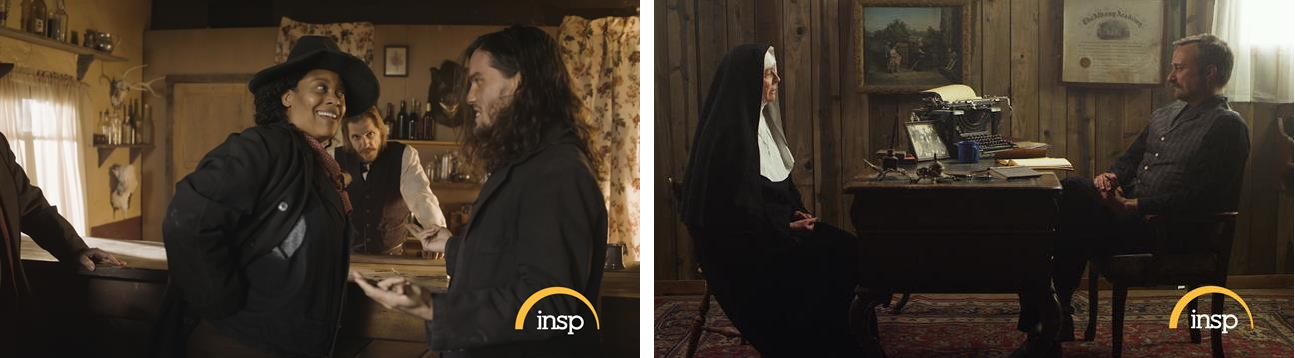
In INSP’s latest episode of Wild West Chronicles, the life of Mary Fields (Cammie Middleton)
is presented in a touching and entertaining story highlighted by themes of friendship, perseverance and courage.

Sister Amadeus (Roslyn Gentle) is invited to Bat Masterson’s (Jack Elliott) ‘Chronicles’ office for her unique recollections on Bat’s new subject. She explains how she met Mary and hired her as a nanny and maid at her convent. The nun and the tomboyish former slave begin an unlikely friendship until the day Sister Amadeus is relocated to a Montana mission.

Once word reaches Mary that Sister Amadeus has pneumonia and may not survive, Mary travels to the mission and insists upon caring for her ailing friend, aiding her with a home remedy and staying by her bedside for a week and a half.


To the astonishment and joy of the other sisters at the mission, Sister Amadeus makes a full recovery and attributes it to her friend and her unorthodox ways. But despite the incident and her role in helping build the mission into a success, the authorities dismisses Mary on account of her hard drinking and brawling reputation.


To Sister’s surprise, Mary remains in Montana and takes a challenging job as a U.S. stage line postal carrier. One day she is held up by the same road agents that previously roughed up one of her drinking buddies. The cocky outlaws think Mary will easily hand over a strong box containing a large payroll but— to say they underestimate the spunky driver is an understatement, at best.

An enjoyable and thoughtful look at an incomparable western figure often forgotten by historians. This installment is must-see viewing and a worthy addition to the Wild West Chronicles pantheon. 
It will air Sunday, June 20th at 5:30PM ET.


   Please post a comment below!   
Monday, June 7, 2021

Wild West Chronicles— The Hunt for Outlaw Bill Doolin


By Christopher Robinson
WMD Senior Editor

Another incredible true tale of the Wild West is detailed to Bat Masterson (Jack Elliott) by his own former deputy, Bill Tilghman who recollects the time he aided in tracking down the outlaw killer Bill Doolin and his notorious Wild Bunch.

Tilghman begins his story with the formation of a posse of marshals in Oklahoma Territory set to bring in Doolin, led by lawman Heck Thomas. Thomas is aggressively reluctant to rely on outside assistance with tensions running high among the uneasy alliance but they soon unite to carry out their shared mission.

A chance encounter in a ‘hot springs’ provides a lone Tilghman with an opportunity to capture Doolin (Joshua Feinman) alive, but only after some tense moments that end with Tilghman getting the jump on the crafty outlaw.

Unfortunately, while Thomas and Tilghman are away from their jail, Doolin overcomes the other marshal and escapes, leading them on another manhunt in the dark cover of night.

The relentless determination and courage of the Old West’s U.S. Marshals is portrayed suitably in a gritty and riveting episode which delivers on action, suspense and historical narrative.

The Hunt for Outlaw Bill Doolin will premiere this Sunday, June 13th at 5:30PM ET and re-air Friday, June 18th at 11PM ET. Find out where to watch. https://www.insp.com/


Be sure to visit
THE TV WESTERN AND MOVIE FAN PAGE
on Facebook!


   Please post a comment below!